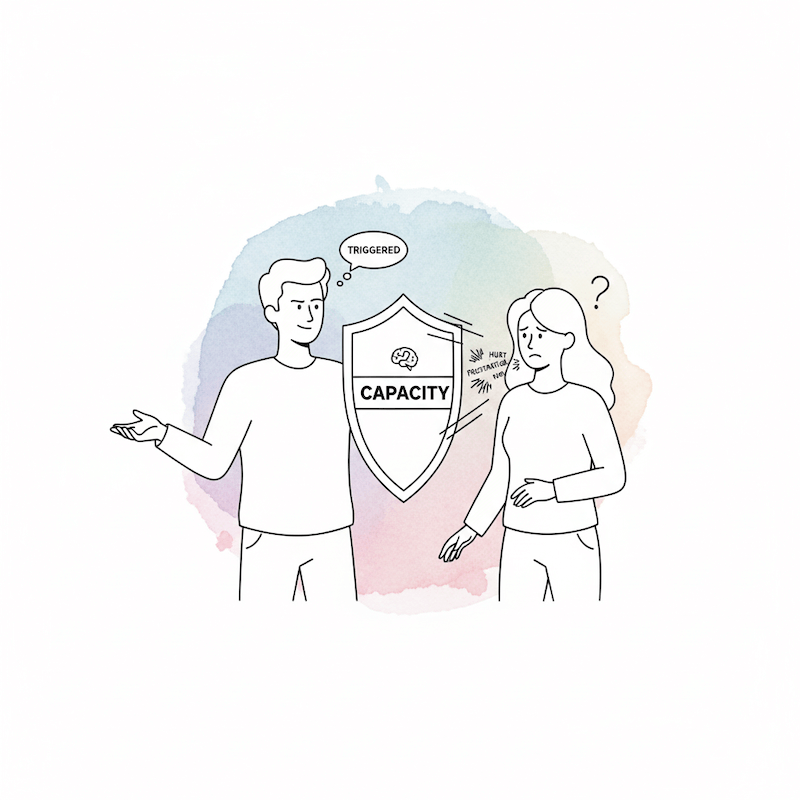
It’s hard to stay mad at a guy who tells you he doesn’t have the ‘emotional capacity’ to listen to your work drama.
Even though you’re pretty sure that’s just a fancy way of saying he wants to play Elden Ring in peace.
We live in the era of the “Self-Actualized Man.”
He’s been to a few sessions of therapy (or he follows three “mental health” accounts on Instagram), and he has the vocabulary to prove it.
He talks about boundaries and triggers. He talks about holding space.
On the surface, this is great. We love a man who knows his amygdala from his elbow.
We love a man who isn’t afraid to use the word “vulnerable” without flinching.
But there’s a dark side to this new linguistic trend.
There’s a growing population of men who have learned how to use the language of healing to justify the behavior of a jerk.
It’s the “Therapy-Speak” Gaslight. It’s when he uses clinical terms to shut down your valid feelings, avoid accountability, and make you feel like you are the one being “toxic” for simply having a human reaction to his nonsense.
How he weaponizes “boundaries”
The most common victim of the therapy-speak trend is the word “boundary.”
A real boundary is something you set for yourself to protect your peace. It looks like this: “I don’t stay in conversations where I’m being yelled at”.
A therapy-speak weaponized boundary is something he uses to control you. It goes like this: “It’s my boundary that I don’t answer texts after 7 PM, so you’re actually disrespecting my mental health by asking why I didn’t reply to your emergency”.
See the difference?
One is about self-preservation; the other is about avoiding the basic responsibilities of being in a relationship.
When you bring up a concern—say, the fact that he’s been acting distant—and he responds with, “I’m currently focusing on my emotional regulation, and I don’t have the capacity for this narrative,” he isn’t being healthy.
He’s being a brick wall with a Ph.D. in Deflection.
How to recognize the “emotional capacity” out
We all have days when we’re drained. We all have moments where we truly cannot take on one more thing.
In a healthy relationship, you say, “Hey, I had a brutal day at work, can we talk about this tomorrow when I can actually give you my full attention?”
In a therapy-speak gaslight situation, “capacity” becomes a permanent shield that he uses to opt out of any conversation that makes him uncomfortable.
He uses it to avoid supporting you through a hard time.
He uses it to justify being a “fair-weather” partner.
If he only has the “capacity” for you when things are light, fun, and easy, he isn’t your boyfriend—he’s your cruise director.
A real partner doesn’t check their “emotional bandwidth” before deciding whether or not to care that you’re crying.
They show up because they’re invested, not because their internal battery is at 100%.

How to avoid the validation sham: “I hear you, but…”
The most infuriating part of the therapy-speak gaslighter is the “Validation Sham.”
This is when he uses the literal scripts of a therapist to make you feel “seen” while simultaneously dismissing everything you just said.
“I hear that you’re feeling frustrated that I forgot our anniversary, and I want to acknowledge that your feelings are valid. However, I’m feeling really judged right now, and I need to prioritize my peace by ending this conversation.”
Translation: I know I messed up, but I’m going to make the fact that you’re upset about it the ‘real’ problem, so I don’t have to apologize.
It’s a masterclass in redirection. By using the words “validate” and “prioritize my peace,” he makes it impossible for you to keep arguing without feeling like a “high-conflict” person.
He’s effectively forced you into a corner where your only choices are to drop your valid grievance or be labeled “emotionally immature.”
Here’s the difference between healing and hiding
Let’s be clear: Therapy is amazing. Language is powerful. Knowing how to communicate your needs is a vital life skill.
But communication is meant to foster connection, not create distance.
A man who is actually doing the “work” will use therapy-speak to move toward you.
He’ll say, “I’m feeling triggered right now, and I’m starting to shut down. Can you give me ten minutes to breathe so I can come back and finish this conversation with you?”
A man who is using therapy-speak to gaslight you will use it to move away from you.
He’ll say, “Your energy is very heavy right now, and it’s affecting my alignment. I need you to go.”
One is a request for a pause; the other is a dismissal of your existence.
How to handle the clinical gaslighter
So, how do you talk to someone who thinks they’re the smartest person in the room because they know what “gaslighting” means (even as they’re doing it)?
- Call out the behavior, not the vocabulary. Don’t get caught up in a debate about the definition of “capacity.” Say, “I understand you’re tired, but I need twenty minutes of your time to resolve this so I can feel secure. Can we do that?”
- Refuse to be the “Patient.” If he starts analyzing your “unprocessed trauma” as a way to avoid talking about why he lied, stop him. “I’m not in a therapy session right now, I’m in a relationship. I’m asking you why you did X, not for a diagnosis of my childhood.”
- Watch the “Peace” vs. “Accountability” Balance. If his “peace” always requires you to be silent about your needs, it’s not peace—it’s a dictatorship with better branding.
The Bissful Perspective: Don’t let him “hold space” you to death
You don’t need a man who knows all the right words; you need a man who does the right things.
A guy who says, “I’m sorry, I was a jerk, how can I fix it?” is worth ten guys who tell you they’re “processing the spatial dynamics of our interpersonal conflict.”
Relationships are messy. They require us to occasionally have “low capacity” and still show up.
Relationships require us to have our “peace” disturbed by the person we love because their problems are our problems.
Don’t let him use a self-help book to stay selfish. You’re looking for a partner, not a clinical supervisor.
Has a guy ever used “therapy-speak” to get out of an argument? What’s the most ridiculous phrase he used to avoid taking the blame? Let’s talk about it in the comments (if you have the emotional capacity, obviously).